
After watching Luka Dončić live, Shaquille O’Neal admitted something rare: he still doesn’t fully understand how Luka dominates NBA games. Dončić isn’t the fastest, strongest, or most athletic star — yet defenses consistently fail against him. The explanation reveals not just Luka’s greatness, but the very logic of modern NBA basketball.
Luka Dončić Is Not the Best Player — He Is the Blueprint
When Shaquille O’Neal recently said he had long criticized Luka Dončić before finally seeing him live, his conclusion surprised many. Luka didn’t overwhelm with speed or explosiveness. He didn’t jump over defenders or blow by them. Yet possession after possession, the result was the same: defenders lost, the offense succeeded.
At first glance, Luka Dončić seems fully understood. He is a tall primary ball-handler, a high-level shooter, an elite passer. But that description never feels sufficient. Plenty of players share parts of that skill set. Only one turns it into something defenses cannot decode.
What separates Dončić is not a single skill, but a unifying principle — the ability to combine intelligence, tempo control, physical awareness, and rule mastery into a coherent system. That system is what people casually call Luka Magic.
Why Luka Represents the Modern NBA Better Than Anyone Else
The NBA is filled with stars who define excellence in different ways. Nikola Jokić dominates through efficiency and vision. Shai Gilgeous-Alexander embodies modern scoring versatility. LeBron James remains the most iconic figure of his generation.
Luka Dončić, however, represents something slightly different. He is not merely one of the league’s best players — he is the clearest expression of where the NBA has been heading for years.
The league has slowly evolved toward creators who control the entire offensive ecosystem. Players who read the game faster than defenders can react. Players who thrive in space, manipulate rules, and dictate tempo. Dončić is not an accident of talent; he is the logical outcome of this evolution.
That is why his arrival in Los Angeles felt symbolic. It looked less like a transfer and more like a generational handoff. If one player can explain what the NBA looks like in 2026, Luka Dončić is that player.
Offense Without Physical Dominance — And Why It Still Works
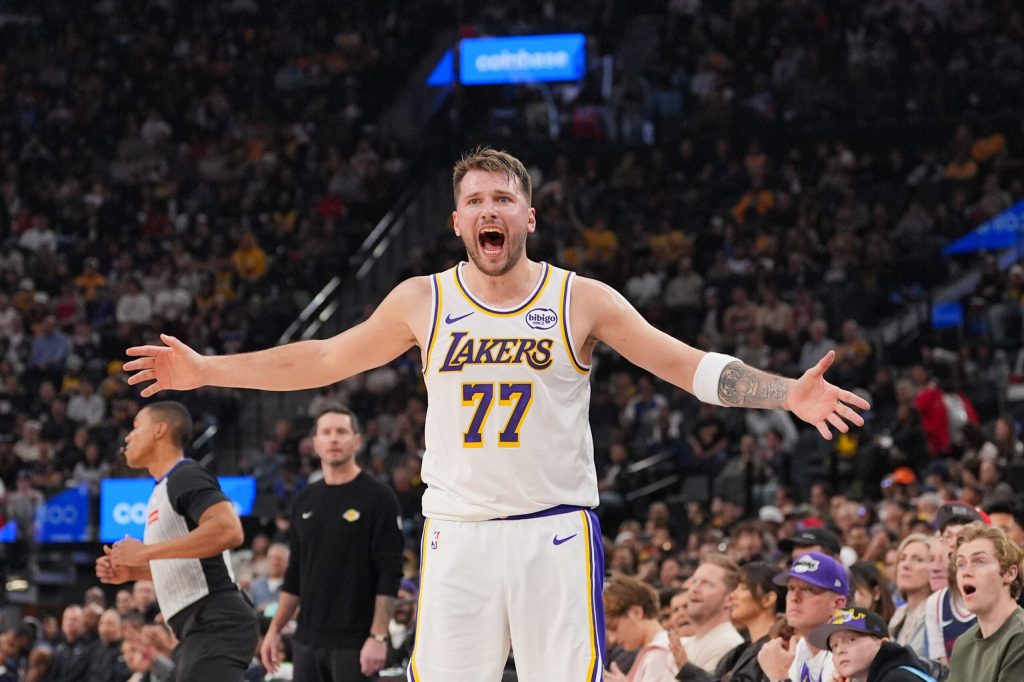
The simplest way to describe Luka Dončić’s offensive game is also the most accurate: he can do everything. He scores in the post, runs elite pick-and-rolls, isolates comfortably, creates shots late in possessions, and punishes even the smallest defensive error.
What makes this remarkable is what he doesn’t have. Dončić lacks a lightning first step, elite straight-line speed, and top-tier vertical athleticism. These are typically considered essential tools for offensive superstars. Luka simply learned to work around them.
He uses his body to shield defenders, his balance to maintain control through contact, and his understanding of space to create angles. He consistently places defenders on his back, seals them off, and finishes with efficiency. His 91.5% conversion rate at the rim is not a product of athletic dominance, but of positioning and timing.
Most importantly, Dončić always has a solution. If the defense overplays, he draws contact. If help arrives late, he passes. If no help comes, he finishes himself. Against Luka, every defensive mistake becomes a scoring opportunity.
A Basketball Education Built From the Ground Up
Luka Dončić did not stumble into this understanding of the game. He grew up inside basketball culture. His father, Saša Dončić, played professionally for nearly two decades, giving Luka early exposure to locker rooms, film sessions, and tactical conversations.
From a young age, Luka played against older competition. Coaches quickly realized he did not merely keep up — he controlled games. Even as a teenager, teammates described him as calm, confident, and unusually composed.
His development accelerated at Real Madrid, where he became European champion, EuroLeague MVP, and EuroBasket gold medalist before turning 20. Few players in history entered the NBA with such a diverse competitive background. Street basketball, elite academies, international tournaments — Dončić experienced all of it.
That breadth matters. It shaped a player who doesn’t rely on instinct alone, but on understanding.
Why Playing Multiple Sports Made Luka Better
Unlike many modern prospects, Dončić did not specialize early. He played football, volleyball, tennis, trained gymnastics, and swam. Those experiences refined his footwork, balance, and spatial awareness — qualities that now define his basketball game.
Sports science increasingly warns against early specialization, and Luka’s career supports that view. His ability to absorb contact, maintain balance, and adjust mid-movement stems directly from his multi-sport background.
Even when critics focused on his fluctuating body composition, his coordination and control never disappeared. Dončić understands when contact benefits him and when avoidance is smarter. He rarely lands awkwardly, despite constant physical pressure from defenders.
Speed is helpful. Balance and anticipation are decisive.
The Most Misunderstood Skill in Luka’s Game: Drawing Fouls
Few aspects of Dončić’s game generate as much criticism as his free throw volume. He leads the NBA by a significant margin, averaging over 12 free throw attempts per game. For some viewers, this slows the game and feels excessive.
But drawing fouls is not manipulation — it is mastery.
From his rookie season, Dončić ranked among the league’s best at forcing defenders into mistakes. At 19, he already drew more fouls than established superstars. That requires understanding angles, defensive habits, referee tendencies, and timing.
The Lakers’ whistle did not create this skill. It amplified it. Los Angeles attacks the paint far more aggressively than Dallas did, naturally increasing free throw opportunities. Luka’s approach has not changed. The context has.
He doesn’t exploit referees. He exploits the rules — and that is elite basketball intelligence.
Slowing the Game Until It Belongs to You
Luka Dončić does not chase speed. He controls it.
While most players try to adapt to the pace of the NBA, Dončić forces the NBA to adapt to him. His dribble, body positioning, and anticipation allow him to operate one step ahead. He knows where defenders will move before they move.
He neutralizes double teams not with flash, but with timing. He sees passing lanes before they open. His decisions are immediate because they are pre-calculated.
This ability to slow the game without stopping it is rare. It turns chaos into structure and speed into predictability — always in Luka’s favor.
The Perfect Player for His Era
The NBA has become the most individual-driven team sport in the world. Rules favor offense, spacing, and star control. Elite players dominate possessions and minutes in ways unseen in other team sports.
Luka Dončić fits this ecosystem perfectly. He understands the league, the rules, the incentives, and the gray areas between them. He shifts seamlessly between team basketball and individual dominance, using each when it benefits him most.
He is intelligent enough to see opportunities, talented enough to exploit them, charismatic enough to make them entertaining, and self-aware enough to remain grounded.
Yes, Luka Dončić is fortunate to play in this era.
But the era is just as fortunate to have Luka Dončić.
Related Coverage on NBA Indo
For more NBA news, in-depth analysis, and player features, visit our NBA News section, where we cover the latest stories from across the league.
You can also check out our NBA Results page for up-to-date scores, game recaps, and standings from the current NBA season.